BY
K. ANANTHANATHAN, MA, MSW, RSW
Registered Social Worker with OCSWSSW
BACKGROUND:
As a student of philosophy, I think it is better to explain my understanding of poems in a few words, before writing this article about Kaviarasue Kannadasan’s philosophical Tamil cinema songs and 100th Birthday (June 24, 1927, October 17, 1981) celebration and his contribution to Tamil cinema poems from a philosophical point of view. First, I would like to explain briefly Tamil cultural background. What is culture? Culture has been described by a writer as a “way of life” as “sweetness and light”, as “activity of thought and receptiveness to beauty and human feeling”. These brief descriptions are sufficient to show the comprehensiveness and the indispensability of culture, for one must have a way of life and that way of life should be combined with sweetness and light with beauty and human feeling.
Tamil culture is nothing else but their way of life a pattern of gracious living that has been formed during the centuries of their history. Tamil culture has its worldwide outlook, trade, and navigation, the Tamils eschewed insularity and developed a remarkable universality of outlook and the ideal of the expanding self. Two verses often quoted of Tamil poetry induce one to examine the development of the expanding self within Tamil culture. One is a verse from PURAM. The poem outlines a philosophy of individual dignity, real love, and personal responsibility:
“This world entire is my home,
All mankind my Kinsman,
Nor good nor ill can others do to me,
Sickness and death are nothing new.
Elated we are not by success.
We fret not in defeat, for
Life is a frail boat in a perilous stream
Following its destined course
Seers divine taught us thus-and so
We marvel not at the great
Much less do we despise the low”.
Kaniyan Punkunran.
(Verse 192 Purannuru)
The above verse sums up effectively the important aspects of the social, cultural, religious, and philosophical traditions in Tamil culture. Kaviarasar Kannadasan always express and reflected this Tamil real love or unconditional love through his poems, speeches, and writings.
Human life is caught in the ceaseless movement of time, of perpetual coming-to-be and passing-away. The changing forms of human life and of native have captured man’s reflective attention in the East and West throughout the ages by shaping the main thrust of his philosophical quest and by posing the basic questions of his religious life. Consider for a moment the perpetual change of role, seen and actor in nature’s theater: Summer’s growth becomes fall’s harvest; night following day, clouds of white alter into ominous thunder heads. Children grow into aged men. Is it surprising that the earliest thinkers were amazed at the transience of all forms and contents of the world, including themselves? Yet such coming to be and ceasing to be essentially define time. In this maelstrom of change man has sought to understand the meaning, of the life given to him and its relationship to the nature of all beings. What I am emphasizing here is that the poet’s and the philosopher’s questions are the same. Ultimately what is the purpose of human life? Subramanya Bharathi also asking the same question in his poems.
Good poets whatever their time, nationality, and language are exceptional beings and carriers of divine truth. The only significant difference from poet to poet is perhaps the difference in the chronology of their lives. In the external forms of poetry, such as technique and style, certain differences may exist among them; but all true poets belong to the one unit and whole of poetic genius. Each poet in his own manner brings to this world a new message, a new form of reality. This message is the truth of creation. A poet tries to express this ultimate reality in order to inspire human beings. hThis reality is expressed in a language that is suited for a period in time and for social way of thinking. It is because reality is affected by units of time, tradition, and society, that a poet attempts to express this reality in terms of those units.
As poetry can distil the sensuous enjoyment of all the senses and as it is born in the very deep experience of those senses ultimately perceiving the aspect of ultimate reality, it carries with the intoxication of liquor, the sweetness of a limitless firmament. Poetry is born over a very deep experience of the senses, the intellect, the mind as well the spirit. Without separating the joy or the sorrow of the world, a poet looks at life, at the completeness of the world of joys and sorrows. One who merely looks at the joy of life and runs away from its sorrows cannot be a true poet; on the contrary poetry is the expression of the frenzy arising from the intoxication of life. Poetry is born of the experience of the harmonies of the world and great passion that emanates from experiencing the tiniest joys of the universe. Not only joy, but sorrow too is a note in the harmony of the world. The above aspects we can clearly see in the works of Kaviarasar Kannadasan. The life vision of completeness of life is the primary experience of Indian poetry. Kaviarasar Kannadasan belongs to this group of Indian poets as I mentioned in this article earlier like Maha Kavi Subramanya Bharathi who perceived life as whole and complete
BRIEF BIOGRAPHY OF KAVIARASU KANNADASAN:
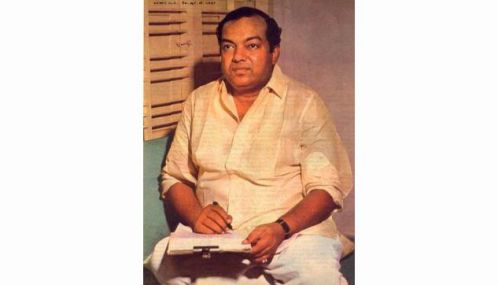
Kannadasan (means Servant of Lord Krishna) June 24, 1927 – October 17, 1981, was a Tamil poet and Tamil Film Lyricist, who was one of the greatest most important Tamil poet after Mavakavi Subramanya Bharathiyar in the Tamil language. Frequently called Kaviarasu (king of poets), was most familiar for his song Lyricist in Tamil films over fifty years and contributed around 5000 Tamil film Lyrics apart from 6000 Tamil poems and 232 books, popular being the 10 parts religious essay on Hinduism (Arthamulla Indhumatham). He was a poet, novelist, Lyricist, politician, film producer, literary editor. His original name was A.L. Muthiah, born in Sirukoodaipathi, Tamil Nadu, South India. Died October 17, 1981 Chicago, in United States. Knnadsan fathered 15 kids in all , by his three wives. He was a prolific poet and prolific father as well. He died at the age of 56 on October 17, 1981in America.
Kaviarasu Kannadasan, the great Lyricist, is still remembered for his embellished language. “I am permanent, I will remain forever”-these are the words of the legend Lyricist that are remembered even today, thanks to his wer-green Lyrics. We feel proud of him. Kannadasan was born on June 24, 1927 to the couple Saththappa Chettiar-Visalakshi as their eighth child. His given name was Muthiah servant of Lord Krishna. Later he changed his name to Kannadasan when he started writing poetry. Born in Sirukudalpatti, in Ramanathapuram District. Kannadasan was given in adoption Pazhaniyappa Chettiar -Sikappiach, couple belonging to Muthupattinam. He was put Mr. Gurukulam High Secondary School in Amaravathiputhier near karaikudi. But his education was discontinued after grade 8 as they could not afford further education. But Kannadasan took great efforts at developing his skills and improving his knowledge.
Thanks to his efforts, he joined as the editor of “Thirumagai”, a magazine published from Pudukottai, at his young age at 17. His poems were published in that magazine. And, he became the editor of “Thirai Oli” in the year 1945 to became the editor of “Chandamarutham”, a magazine, published by Modern Theatres in 1947. Later he resigned from “Chandamarutham” with the goal of becoming Cinima Lyricist and met the concerned people in Jupiter Pictures at Coimbatore. At that time, the film “Kanniyin Kaadhali” was in the making Mr. K. Rammanathan was directing the film. Kaviarasu Kannadasan wrote songs and got introduced to the director by Mr. Venkatasamy, the husband of actress U. R. Jeevarathnem. His Lyrics were approved. His song “Kalangathiru Maname” was sung for heroine Maduradevi by playback singer T. V. Rathinem. Kaviarasu Kannadasan’s first song itself became a hit. And, he started writing dialogues also for Tamil movies. In the meantime, he plunged into politics too. And, subsequently, he became a film producer too. His first production was “Maalaiyitta Mangai” Archi Manorama, who was a stage artiste that time, was introduced to cinema through this film.
SIGNIFICANCE OF HIS PHILOSOPHICAL FAMOUS CINEMA SONGS:
Ponal Pohattum Poda – Intha
Poomiyil Nilaiyai Vazhanthavar – Yaarada
Vanthathu Theriyum Povathuenge
Vaasal Nmakke theriyathu
Vathavellam Thankividdal – Intha
Mannil Namakke Idamtethu
Vazhkai Enpathu Viyaparam – Varum
Jananam Enpathu Varavahum – Athil
Maranamenpathu Selavaahum
English Translation:
Let the Passions and bonds Pass by
Who has lived in this land – Forever?
Path of Arrivals is Known – But
Path of Departure and the route – Unknown
If all who Came opt to stay
Where is the Space in this Sphere?
Life is just a Business – In which
The Birth is Credit and
Death is Debit
Addai Inri Piranthome Assaiinri
Piranthoma?
Adai Mudikkaiyile Alli Chenror
Yaarumundo?
English Translation:
Though Born without a Dress
Did we come without Passions?
When we complete the Merriment
Can anyone carry their Possessions?
Veedu Varai Uravu
Veethi Varai Manaivi
Kadu Varai Pillai
Kadaisi Varai Yaaro?
English Translation:
The children, till the house
The wife, till the street
The son, up to the cemetery
Who will come beyond that?
Ullam Enpathu Aamai – Athil
Unmai Enpathu Oomai
Solil Varuvathu Paathi – Nengil
Thoonkikidappathu Neethi
English Translation:
Mind is like a Tortoise in which
The Truth hides in silence
Words can Bring out only the half
While Justice calmly sleeps
Assaiye Alai Pole
Naamellam Athanmele
Odam Pole Adiduvome – Vaazhkailile
Paruvam Ennum Kaatrrile
Parakkum Kaathal Therile
Aanum Pennum Mahizhvar
Suham Pervvar – Athisayam Kaanpaar
NaallIai Ulahin Paathaiyai Inru
Yaar Kaanuvar?
English Translation:
With Passions as waves
We dance like the boat
In our passage of life
With the wind of youth
By flying in the chariot of love
Men and woman make merry enjoy
And surprise themselves
But who can guess tomorrow’s path
Today itself?
Kaviarasu Kanadasan through these poems trying to reinforce the theme “Sorrows are credit of life while the joys are debit, with the balance being mere dreams, and who can comprehend the arithmetic of fate”.
CONCLUSION:
Kaviarasu Kannadasan is a great accomplisher, having written more than 10,000 songs. Apart from film songs he has written devotional songs, poems, articles, short stories, novels, biographies etc. Totaling around 10,000 poems. Kaviarasu Kannadasan had the integrity and courage to share his views with others. We all should read his books and poems.
They are treasures in the sense that they will clarify all our philosophical doubts and render clarity and calmness of mind. Kaviarasue Kannadasan came to America in July 1981 to participate in the function organized by Tamil Sangam and in the Poet’s conference there, he suddenly developed chest pain and was admitted to a hospital in Chicago town on 24th July 1981 and was given treatment. But he did not respond to the treatment and died on 17th October 1981. He was only 56 years when he died. His body was brought to Chennai with the help of then chief minister MGR and was cremated the next day.
Today, he is not physically presence, but his philosophical writings will stand the test of time and will remain forever in the hearts of the Tamils all over the world. His works prove his words, “I am permanent, I have no death at any point in time”. Though Kaviarasu Kannadasam is no more his song writing and his famous cinema and other poems remain in hearts and minds of his fans and Tamils all over the world. As he mentioned, He is permanent, and he has no death through his eternal Tamil songs and philosophical writings. His publications and poems will amply testify to that. And I also add that Kaviarasu Kannadasan was a distinguished philosopher in his own right and a thinker possessed of powerful mind. He has also a great understanding of Hinduism, philosophical issues from a classical Tamil perspective which I have rarely seen matched. Particularly, his ten parts on Hinduism (Arthamulla Indu Matham). He is one of the kinds of poet who are proficient in Classical Tamil and philosophy in our recent Tamil poets. And, most of all he is a wise man.
Special Article for his 100th Years Birthday celebration.